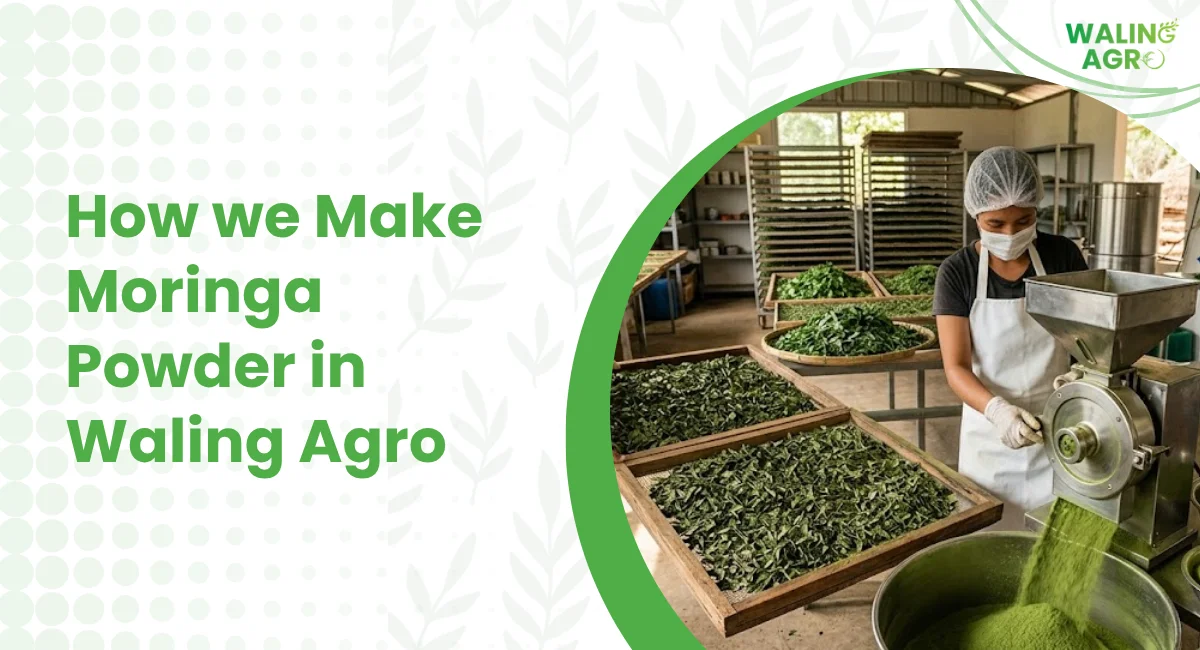
How we Make Moringa Powder in Waling Agro

Moringa oleifera has earned its nickname “the miracle tree” for good reason. A single leaf of this fast-growing, drought-tolerant plant can pack more usable nutrition than many staple vegetables, and once it is dried and ground into a fine green powder.
In Nepal, moringa is called Sitalchini locally, and it grows well across the Terai lowlands and the mid-hill regions where our other crops are also farmed. For generations it has been used as a traditional vegetable and home remedy, and it is only in the last decade that it has started moving from kitchen gardens into commercial-scale production.
At Waling Agro, we process moringa leaves the same way we process every crop like ginger. In this blog, we walk you through our complete moringa leaf powder production process, from harvesting branches in the field to sealing the final airtight pouch, and we back it up with the research and market data that explain why this humble Himalayan leaf is becoming a global commodity.
Why Moringa Leaf Powder Deserves Global Attention
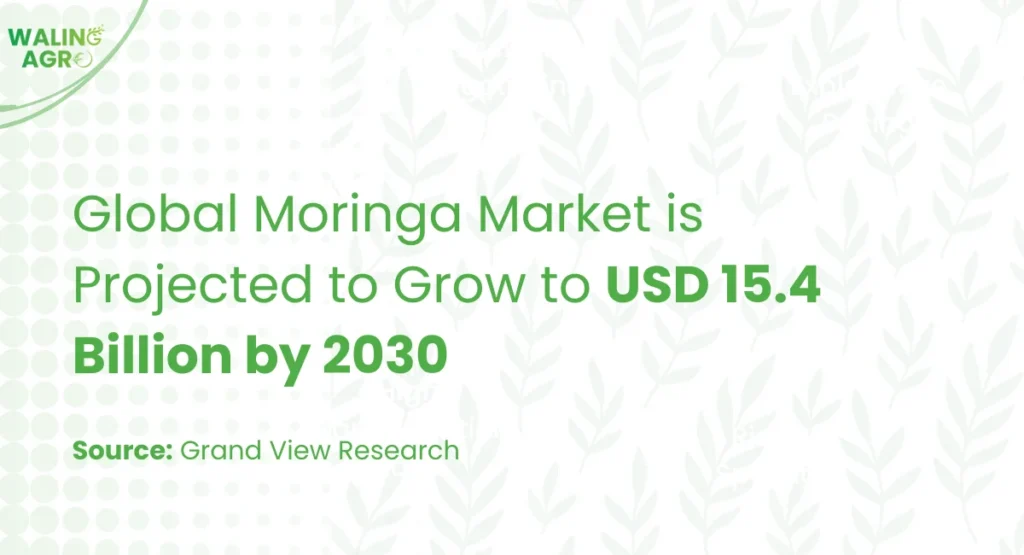
According to Grand View Research, the global moringa products market was valued at USD 8.2 billion in 2023 and is projected to grow to USD 15.4 billion by 2030. Leaf powder is the single largest product category, accounting for 32.9% of total revenue, ahead of moringa tea, oil, and seeds combined.
| Metric | Figure |
| Global moringa products market value (2023) | USD 8.2 billion |
| Projected market value by 2030 | USD 15.4 billion (9.5% CAGR) |
| Leaf powder share of the moringa products market (2023) | 32.9% revenue share |
| Europe’s share of the global market (2023) | 29.4% revenue share |
Why the Leaves Specifically?
Unlike many superfoods that rely on a single standout compound, moringa leaves offer a genuinely broad nutritional profile. Researchers found that moringa leaf powder contains over 25% protein by weight, a level higher than most other high-protein vegetables and comparable to milk, eggs, and meat.
- All nine essential amino acids, making it a rare plant-based complete protein source
- High levels of Vitamin A, Vitamin C, and Vitamin E
- Significant calcium, potassium, and iron content
- Antioxidant compounds including flavonoids and phenolic acids
A peer-reviewed study published via the National Institutes of Health (PMC) measured moringa leaf powder’s protein content at just over 25%, alongside 28.5% carbohydrates and 11.83% dietary fibre, confirming why nutritionists increasingly recommend it as a plant-based supplement. A separate review in PubMed reports a broader range of 20–35% protein depending on growing conditions and leaf maturity.
Our 6 Steps Moringa Powder Production
Every batch of Waling Agro moringa powder passes through six carefully managed stages. We document each one with photographs and video, so we can trace any packet of powder back to the exact batch, harvest date, and processing run it came from.
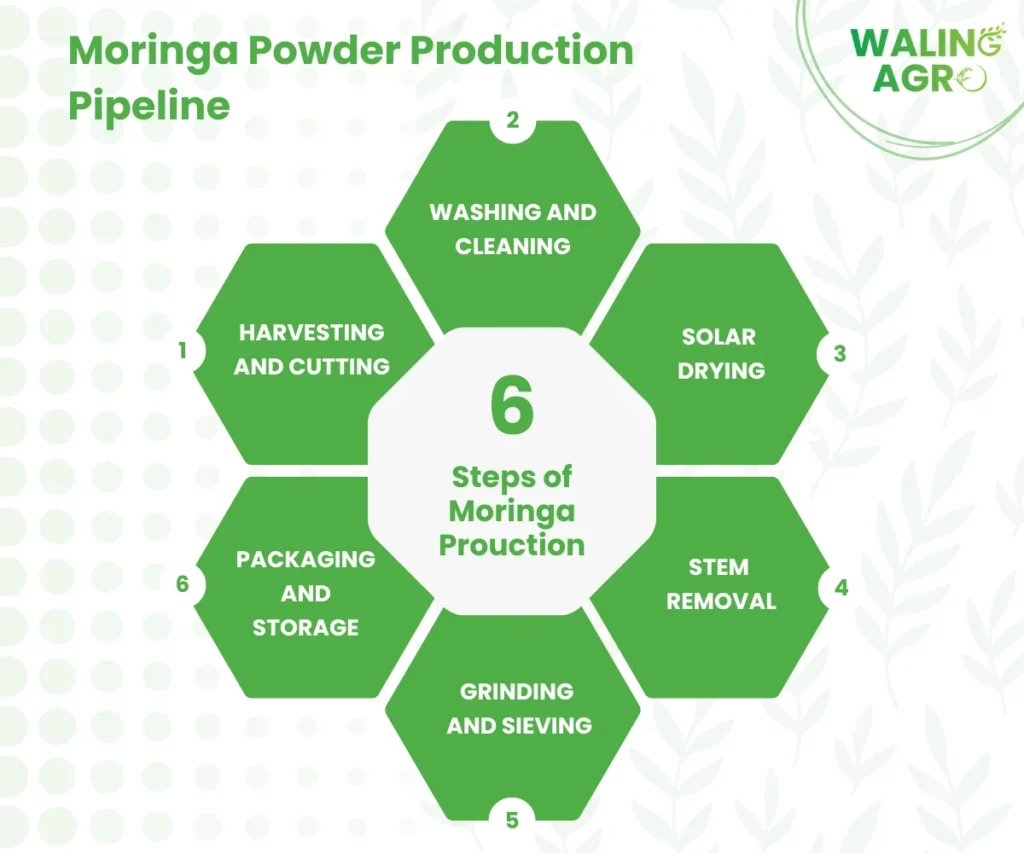
Let’s walk through each step in detail.
Step 1: Harvesting and Cutting
Quality begins in the field. Along with sourcing from local smallholder farmers, we also have our farms. Our team cuts branches directly from the moringa tree using sharp, sterilised shears rather than tearing or snapping them by hand.
- Only healthy, deep green leaves that are still attached to their branches are selected
- Yellowing, pest-damaged, or withered leaves are excluded at the source
- Sterilised cutting tools reduce the risk of introducing bacteria or fungal contamination
This early sorting decision matters more than it might seem. Because dried moringa leaves are usually consumed as a whole-leaf powder rather than an extracted concentrate, any quality issue at harvest carries straight through to the final product.
We also photograph and log every harvest batch at this stage. Recording the collection date, the source farm, and the condition of the branches gives us a paper trail that starts at the very first cut, well before the leaves ever reach our processing floor.
Step 2: Washing and Cleaning
Once branches arrive at our facility, they still carry field dust, soil, and insects. We submerge the harvested branches, leaves still attached, in a basin of clean, potable water and agitate them gently to loosen dirt.
- First soak removes surface dirt, dust, and insects
- A second rinse in fresh, clean water removes any remaining residue
- Washed branches drain on a clean mesh screen before moving to drying
Washing branches with leaves still attached, rather than stripping leaves first, protects the delicate leaflets from bruising and nutrient loss during the wash cycle. It also means every leaflet, gets equal contact with clean water, which matters for a leaf this small and thin.
Water quality is non-negotiable at this stage. Because moringa leaves are typically consumed as a whole-leaf powder without any further cooking or extraction step, contaminated wash water would carry straight through to the finished product. We only use clean, potable water sourced for food-grade processing.
Step 3: Solar Drying
Washed branches move into our solar dryer, where they are spread out evenly to allow consistent airflow across every leaf. Drying is the single most important step for nutrient retention in the entire process, and the research backs this up clearly.
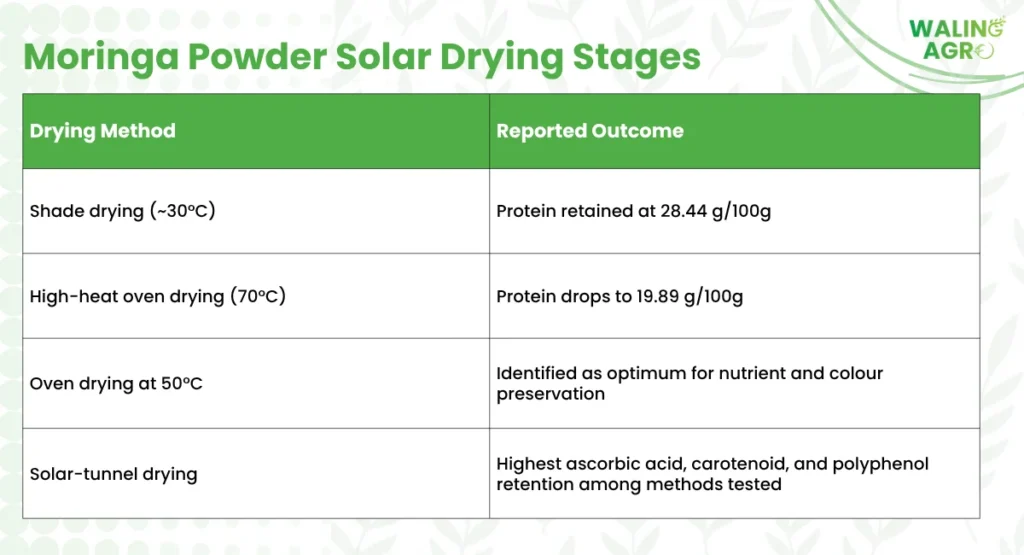
This is precisely why we rely on solar drying rather than high-heat mechanical dryers. Controlled, moderate solar heat removes moisture gradually, which protects the vitamins, chlorophyll, and antioxidant compounds that make moringa valuable in the first place. Leaves are considered fully dry once they turn brittle and crush easily by hand, a simple but reliable field test our team uses on every batch.
Step 4: Stem Removal (Stripping)
Once branches are fully dry, our team manually strips the crisp leaflets from the stems and stalks. This step is done entirely by hand, and it is one we do not rush.
- Stems and twigs are excluded, as they carry a lower nutritional profile than leaves
- Woody material can damage grinding equipment if it is not fully removed
- Only pure, dried leaflets are collected for the next stage
Because moringa leaflets are small and light once dried, stripping requires patience and a practised hand. Rushing this step is one of the easiest ways to end up with a powder that is gritty or diluted with fibrous stem material, something we simply do not allow to reach packaging.
Step 5: Grinding and Sieving
The crisp, dried leaves are loaded into a sterilised grinder or mill and ground until reduced to a fine powder.
- Ground powder is passed through a fine-mesh sieve, typically 80-mesh or finer
- Sieving removes any unground veins or coarse fibres that survived grinding
- Only powder that passes the fine-mesh standard proceeds to packaging
Research on moringa processing published in the Journal of Food Process Engineering also found that moisture content directly affects how well the powder flows and holds together during grinding, which is one more reason our drying stage is so tightly controlled before leaves ever reach the mill.
Step 6: Packaging and Storage
The finished powder is moisture-sensitive and light-sensitive, so packaging happens immediately after grinding, with no delay in between.
- Powder is transferred into airtight, moisture-proof, and opaque containers
- Metallised pouches or dark glass jars are used to block light exposure
- Packaged powder is stored in a cool, dry place away from direct light
Opaque, airtight packaging is not just about shelf appeal. Vitamin C and carotenoids, two of moringa’s most valuable nutrients, are known to degrade when exposed to light, heat, and oxygen. Sealing the powder correctly at this stage is what protects the nutritional work done in every step before it.
Documentation at Every Stage
Throughout the entire six-step process, our production team captures photographs and video footage at every stage, from the first branch cut in the field to the final sealed pouch. This is the same traceability standard we apply across our product range, including our
ginger powder production process, and it means every batch of moringa powder we sell can be traced back to its source.
Moringa Powder Quality Control
Documentation during production is only half of our quality system. Before any batch of moringa powder is approved for packaging, it is checked against a short list of non-negotiable criteria.
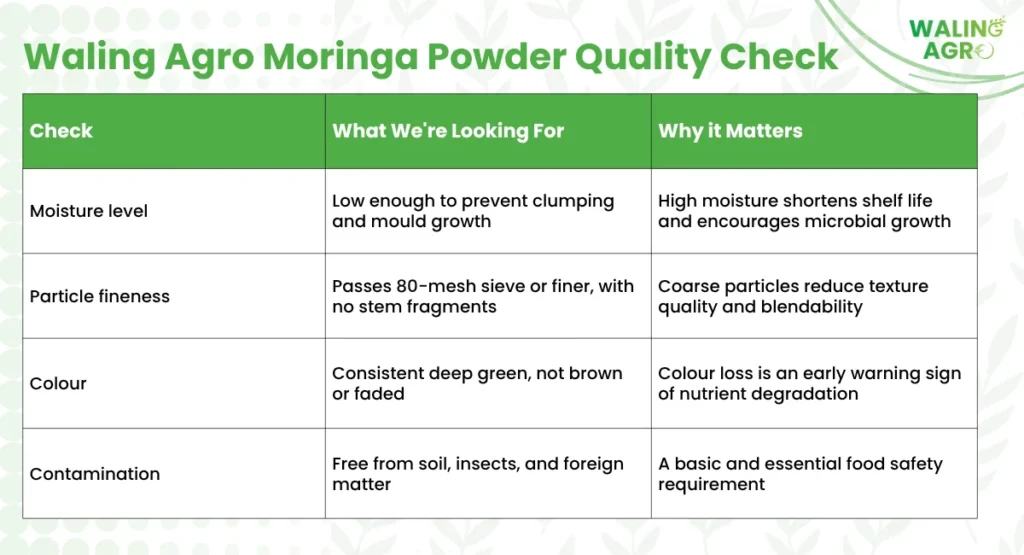
What’s Inside Waling Agro Moringa Powder
Dried moringa leaf powder concentrates the nutrients found in fresh leaves several times over, simply because water weight is removed. Based on published nutritional research, here is what a typical serving profile looks like:
| Nutrient | Typical Range |
| Protein | 20% – 35% by weight |
| Dietary Fibre | ~12% – 38% |
| Vitamin C (solar-tunnel dried) | Up to 471 mg/100g |
| Calcium | Up to 1,751 mg/100g |
| Magnesium | Up to 512 mg/100g |
| Essential amino acids | All nine present |
These figures vary between studies because leaf maturity, growing region, and processing method all influence the final nutrient profile.
How to Use Moringa Leaf Powder
One of the reasons moringa leaf powder has grown so quickly as a category is its versatility. Unlike many superfoods that only work in one format, moringa powder blends easily into everyday routines.
- Stirred into smoothies, juices, or plant-based milk
- Mixed into soups, dals, and curries as a nutrient boost
- Blended into baked goods such as flatbreads, muffins, and energy bars
- Encapsulated as a daily dietary supplement
- Brewed as a herbal infusion or tea
Ready to Try Waling Agro Moringa Powder?
You now know exactly how our moringa leaf powder is made. Every stage is documented, every batch is traceable, and every decision is made to protect the nutrients that make this leaf worth growing in the first place.
If you are interested in wholesale or bulk supply, we would love to hear from you. Reach out to our team and we will get back to you promptly.