Empowering Smallholder Farmers in Nepal

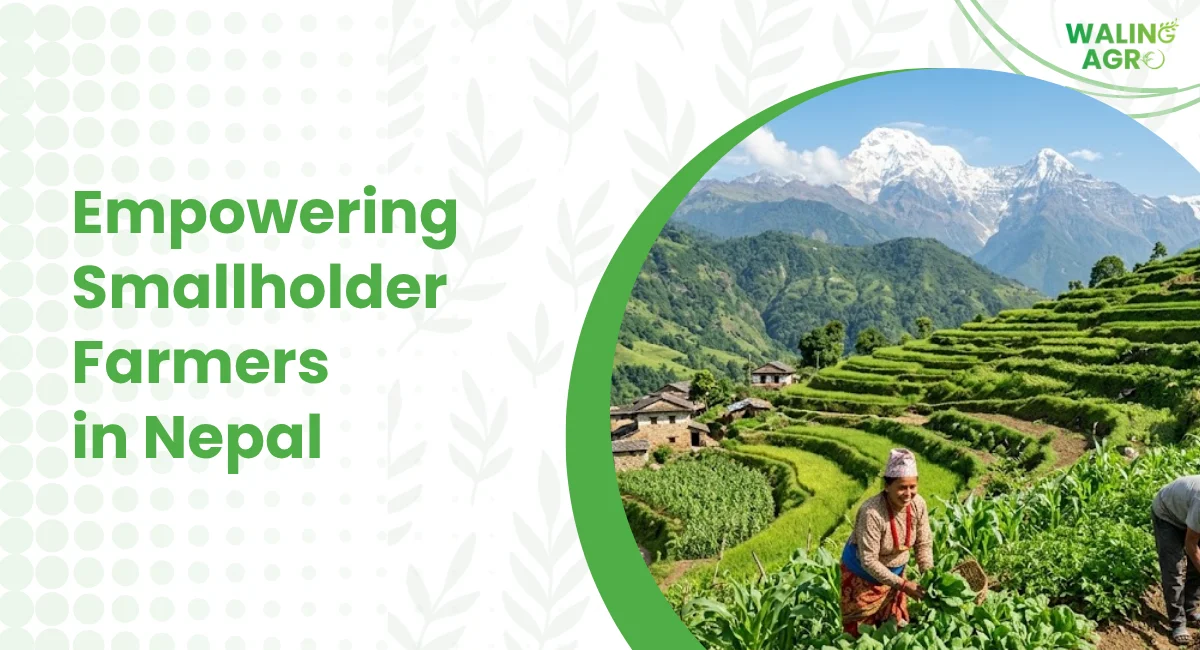
The mid-hills of Western Nepal boast some of the most beautiful geography on earth, but this rugged terrain makes traditional agriculture incredibly difficult. While commercial farms dominate the food supply chain, Nepal’s steep hillsides simply cannot support that kind of scale.
Despite these geographical limitations, agriculture remains the undeniable heart of the nation, employing over 61% of the country’s workforce. If large corporate farms aren’t mainstream, the heavy lifting falls directly on the shoulders of the smallholder farmer.
These local village households cultivate small plots of ancestral land, relying on generations of traditional farming knowledge to survive.
Nepalese Agriculture by the Numbers
To truly understand the importance of Waling Agro’s mission, it helps to look closely at the numbers shaping our nation’s agriculture. Farming in Nepal is not defined by sprawling, mechanized fields, but rather by fragmented, tightly managed plots.
In fact, an 70% of Nepal’s food is produced by smallholder farmers, making them the true engine of our country’s food security. However, these farmers accomplish this monumental task with very little land to work with.
Average Land Ownership of a Farmer
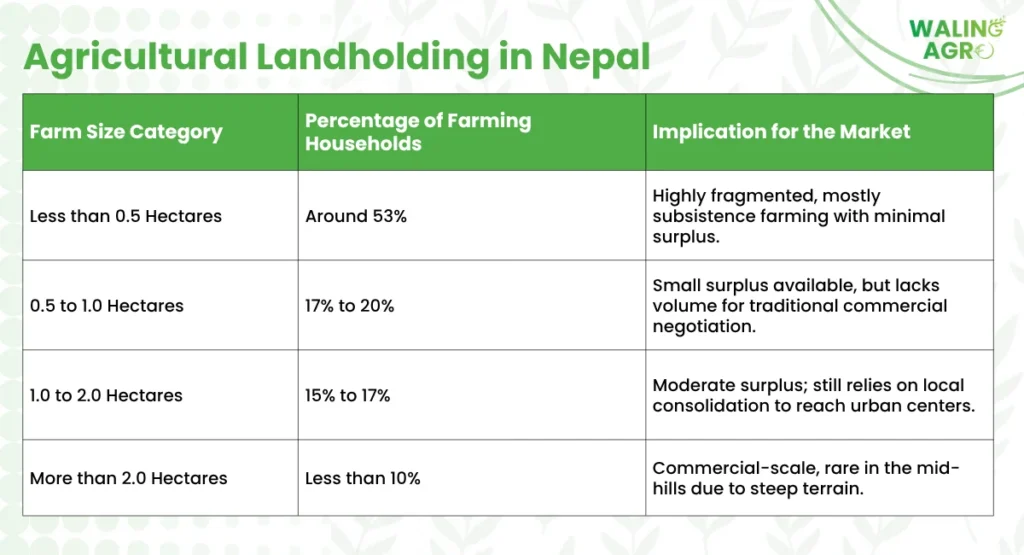
National statistics reveal that the average farm size in Nepal is 0.6 hectares. Even more striking is that 52.7% of all farming households operate on less than 0.5 hectares of land, which is often further divided among family members. This severe land fragmentation makes it incredibly difficult for a single family to grow a large enough surplus to sell commercially.
This challenge is felt most deeply in the mid-hill region. Here, farmers must carve terraced steps into steep hillsides to prevent soil erosion, naturally limiting how much land they can cultivate.
As a result, families might grow a small, premium surplus of turmeric, black cardamom, or Lapsi, but they lack the volume to negotiate fair prices with traditional buyers.
Agricultural Landholding in Nepal
When over half the farming population operates with less than half a hectare, the traditional bulk-buying model completely breaks down. Without a dedicated buyer, small yields of valuable spices often go to waste or are sold for pennies to predatory middlemen.
Reality and Challenges of the Mid-Hill Farmer
Farming in the mid-hills is an ongoing battle against the logistical and economic realities of rural geography. For a smallholder farmer managing a half-hectare plot, the daily routine involves incredible manual labor to yield small but premium harvests.
Why Major Buyers Overlook Smallholders
Small-holding farmers produce in limited, fragmented batches, perhaps a 50-kg sack of ginger or a modest harvest of turmeric; they inherently lack the volume to directly entice major commercial buyers.
Traditional agricultural markets are built entirely on the concept of economies of scale. They heavily favor bulk suppliers who can deliver metric tons at a time, ensuring processing facilities run efficiently. This foundational market structure completely sidelines the mid-hill farmer, forcing them to rely on localized, often exploitative systems.
The Middleman Problem
The most significant hurdle arising from this lack of scale is the pervasive, deeply entrenched middleman problem. Because a single farmer cannot influence market prices or attract bulk buyers on their own, they are exceptionally vulnerable to exploitation by intermediaries.
Middlemen act as the necessary aggregators, traveling through remote hill communities to consolidate these micro-harvests into commercially viable quantities. While they provide an essential bridge to urban wholesale centers, they often dictate severely depressed farm-gate prices.
As the farmer has no alternative buyer, they must accept whatever price is offered. In extreme cases, the price doubles or triples when the product reaches retail stores. This means the farmer, who put in months of backbreaking work and assumed all the agricultural risk, receives only a fraction of the final retail value.
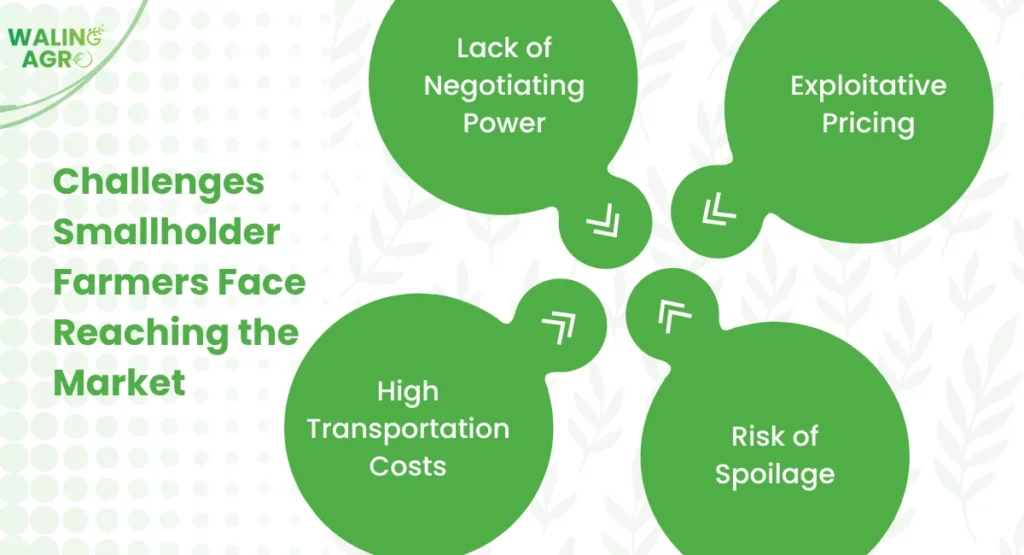
Challenges Smallholder Farmers Face Reaching the Market
After economic exploitation is the logistical nightmare of mid-hill farming. Even if a farmer wanted to bypass the middleman and sell directly to a city market, poor market access and treacherous road conditions create massive, often insurmountable barriers.
Hiring private transport for a small 100 kg batch of Akabare chilies down a winding, unpaved hill road often costs more than the crop itself is worth. As a result, farmers are trapped by their geography, facing a frustrating set of interconnected challenges:
The Waling Agro Solution
When a traditional agricultural system is built to serve massive bulk commodities, the high-quality, authentic produce of the individual micro-farmer is often severely undervalued. Waling Agro was established in the heart of Western Nepal to fundamentally disrupt this cycle.
Our Philosophy
Our core philosophy represents a radical shift in perspective for the regional supply chain: absolutely no harvest is too small to be valued. Rather than demanding massive commercial yields, we have adapted our entire business model to meet the farmers exactly where they are.
We believe that the future of Nepalese agriculture depends on adapting to the hills, not forcing the hills to adapt to commercial demands. To achieve this, our buying mechanism is purposefully designed to accommodate the fragmented reality of mid-hill agriculture.
Our Purchasing Model
Waling Agro’s purchasing model is built to be inclusive and localized, ensuring that the geographical challenges do not prevent farmers from accessing a fair market. By sourcing directly from village households, we allow farmers to focus on what they do best while we handle the complexities of large-scale supply chain logistics.
- Flexible Volume Acceptance: We accept harvests of all sizes, from a modest 10 kg basket to a 500 kg batch, ensuring no farmer is turned away due to low yield.
- Direct Sourcing of Heritage Crops: We specialize in essential regional spices and fruits, including ginger, turmeric, black cardamom, and Lapsi, sourced straight from the farm gate.
- Internal Volume Aggregation: By collecting micro-harvests and consolidating them at our own facilities, we remove the “burden of scale” that usually crushes smallholders.
- Quality-Centric Rewards: Every batch undergoes a rigorous quality assessment. This ensures farmers are paid based on the premium nature and careful cultivation of their crops rather than just the total weight.
Direct Payments for Financial Security
Perhaps the most transformative aspect of the Waling Agro model is our unwavering commitment to direct and immediate payment. In traditional middleman networks, smallholder farmers are often forced to sell their goods on credit. They end up waiting weeks or even months to receive their depressed earnings, which creates immense financial anxiety.
By acting as the direct, reliable bridge between the farm and the processing industry, Waling Agro completely eliminates these predatory intermediaries. We assess crop quality on the spot and hand the cash directly to the farmer. This transparent approach injects vital, reliable cash flow directly back into the rural households that need it most, empowering them to invest in their families and their land.
The Bounty of the Hills
The limited-scale farming is actually a hidden advantage in terms of sheer product quality. Because smallholders are not trying to manage thousands of acres of land, they can apply focused, traditional care to their crops, avoiding heavy chemical interventions.
This hands-on approach results in incredibly authentic, premium produce that holds immense value in both local and international markets. We specifically target the unique spices and cash crops that naturally thrive in the diverse microclimates of Western Nepal.
By providing a guaranteed, reliable market for these specific products, we ensure that historically and culturally significant harvests continue to flourish. Our facility aggregates these highly localized crops to meet broader market demands without ever compromising on quality.
What We Source From Farmers
Here is exactly what we actively source directly from the hands of local farmers:
- Ginger & Turmeric: Nepal is recognized globally as a leading producer of ginger. Cultivated organically in the rich, well-drained soils of the hills, these essential root spices boast intense flavors and high nutritional value, making them indispensable for both daily household cooking and premium commercial spice processing.
- Akabare Chilies: Famous for their intense, fiery heat and distinct flavor profile, cultivating these highly sought-after chilies requires exact, hands-on attention. Smallholder farmers are uniquely positioned to provide the careful, manual harvesting techniques needed to maintain the delicate quality of Akabare.
- Black Cardamom & Lapsi: Nepal holds the prestigious title of being one of the top producer of large black cardamom, a high-value cash crop that thrives perfectly in the shaded, moist microclimates of the hills. Alongside unique regional fruits like Lapsi (Nepali hog plum), sourcing these native crops provides a massive economic boost to individual households.
Socio-Economic Impact: Beyond the Harvest
The impact of our direct-buying model extends far beyond simply securing high-quality agricultural ingredients. When smallholders are constantly excluded from traditional markets due to low production volumes, the socio-economic consequences are devastating.
Frustration and lack of income frequently lead to widespread abandonment of arable land and mass out-migration, as rural youth leave their villages to seek more reliable labor abroad. By stepping in as a guaranteed, fair-paying buyer right in the community, Waling Agro provides a vital economic lifeline that actively combats this damaging trend.
How We Motivate Smallholder Farmers
When farmers know for certain that there is a willing buyer for their spices, regardless of volume, their entire outlook shifts. This market guarantee motivates them to continue cultivating their ancestral lands, optimizing their small plots rather than letting them go barren.
Furthermore, our system of direct, immediate cash payments injects crucial liquidity into village households. This reliable extra income is transformative, providing families with the financial stability needed to fund education, healthcare, and improve living standard.
Waling Agro’s Long-Term Goal
Ultimately, our mission is anchored in community development. By prioritizing the micro-farmer over the corporate aggregator, our daily operations trigger a ripple effect of positive, long-term benefits:
- Retention of Agricultural Heritage: By making small-scale farming profitable and dignified again, we are actively encouraging the next generation to stay. This keeps the invaluable traditional farming practices alive and deeply rooted in the region.
- Economic Circulation: By eliminating external middlemen, cash paid directly to farmers circulates repeatedly within the local village economy, uplifting local businesses.
- Empowerment of Marginalized Growers: We provide a reliable, profitable platform to the vulnerable, small-scale producers who are otherwise completely invisible and inaccessible to commercial buyers.
Conclusion
Nepal’s difficult terrain may not be suited to mechanized commercial farms, but they don’t need to be. The collective power, dedication, and traditional expertise of our smallholder farmers are more than enough to cultivate world-class agricultural products.
At Waling Agro, our long-term vision is built entirely around championing these resilient smallholder framers. When you choose to partner with or purchase from us, you are actively investing in the livelihood, dignity, and future of the hardworking farmers.