Why Social Entrepreneurship is the Future of Sustainable Farming

The global food system is broken, not in the sense that it fails to produce enough food. The system is designed in such a way that the people who grow it are often the last to benefit from its value.
The world’s 600 million smallholder farmers, working on less than two hectares of land each. They produce an estimated 30 to 34% of the global food supply, yet many of them live in poverty, are systematically underpaid by middlemen, and are invisible to the markets that profit from their labour.
At Waling Agro, our entire business model is built on the conviction that sustainable farming and rural economic empowerment are not separate goals.
The Scale of the Smallholder Farmer Problem
To understand why social entrepreneurship matters in agriculture, you first need to understand the scale of what the conventional system has failed to address.
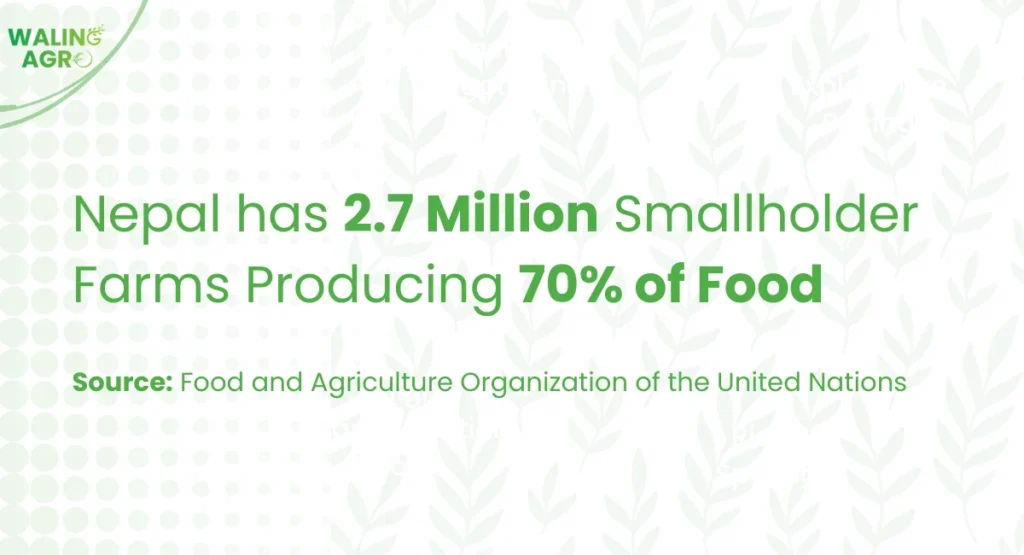
There are an estimated 570 million farms worldwide, and 84% of them, nearly half a billion, are smallholdings of less than two hectares in size. These are not marginal operations. According to the FAO, in Nepal alone, 2.7 million smallholder farms account for 70% of the food produced in the country.
Globally, farms of less than five hectares in developing countries account for more than half of the global production of nine staple crops; including rice, wheat, potato, maize, and barley.
Despite this enormous productive contribution, the World Bank estimates that 500 million smallholder households make up a significant portion of the world’s poor, many living on less than two dollars a day. They grow the food that feeds the world while struggling to feed themselves. This is the defining contradiction of the modern food system.
The Middleman Problem
The primary mechanism through which smallholder farmers are economically marginalised is the intermediary supply chain, a network of middlemen who aggregate small harvests and sell them upstream at dramatically inflated prices. Because individual smallholders cannot produce at the volumes required by commercial buyers, they have no alternative but to accept whatever price local intermediaries offer.
In Nepal’s mid-hill region, this dynamic is particularly acute. A farmer who grows ginger or turmeric on half a hectare of terraced land cannot realistically transport a 50-kilogram batch down a mountain road to a city wholesale market. The cost of private transport alone would eliminate the profit margin.
So they sell locally, to the trader who arrives at the village, for a price set entirely by that trader. As a report from the Kathmandu Post has documented, the price of agricultural produce can double or triple by the time it reaches retail consumers.
The Rural Youth Migration Crisis
The economic exclusion of smallholder farmers feeds directly into a systemic crisis: the collapse of rural agricultural communities through youth out-migration. When farming offers only poverty-level returns, the younger generation is forced to look elsewhere for a viable future.
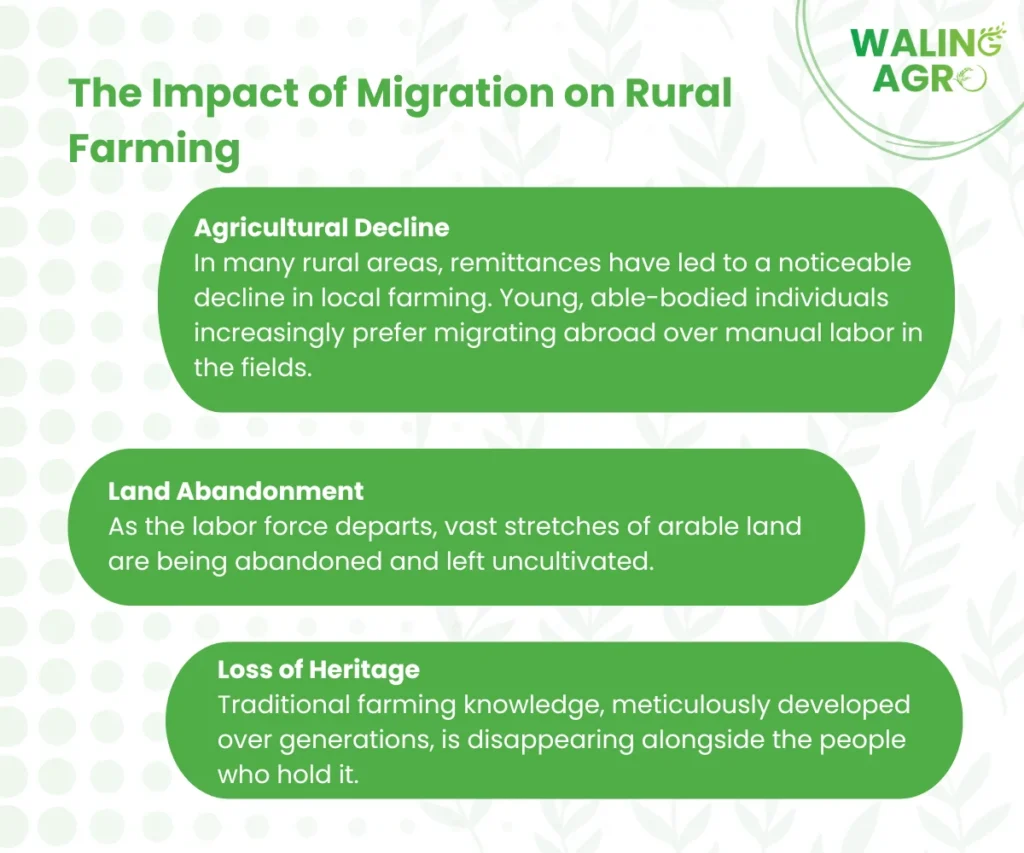
The Impact of Migration on Rural Farming
Currently, nearly 3.7 million Nepalis work abroad. This mass exodus has transformed the traditional rural structure:
A Threat to National Food Security
This phenomenon is a fundamental threat to food security. Peer-reviewed research confirms that out-migration in Nepal has climbed steadily over the last two decades. Studies consistently show that the preference for non-farm work, particularly among educated youth, is the primary driver behind land abandonment.
Ultimately, an agricultural supply chain that fails to provide a living wage for its farmers is a supply chain that is effectively destroying itself from the inside out.
The Role of Social Entrepreneurship in Agriculture
Social entrepreneurship represents a model where commercial viability and social impact are structurally inseparable. Social enterprises utilize business innovation to tackle complex social and environmental challenges that neither the private market nor the public sector has successfully addressed.
In the agricultural sector, these failures are manifest in smallholder market exclusion, environmental degradation from industrial farming, and widespread rural poverty. Social entrepreneurship steps into this gap, offering a governance model that prioritizes the producer as much as the product.
Comparative Impact of Agricultural Models
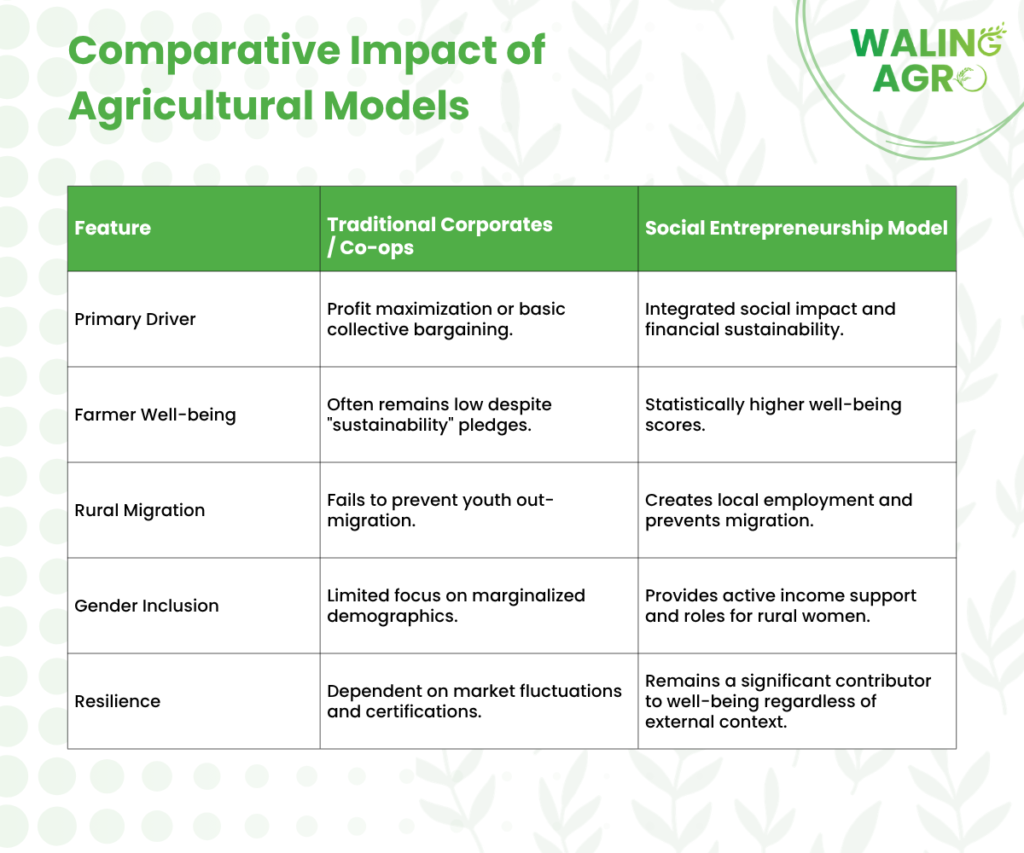
The effectiveness of social enterprises is backed by recent academic research, including a 2026 study in Communications Sustainability. The following table illustrates how social entrepreneurship outperforms traditional frameworks:
The Core Mechanisms: Why It Works
Social entrepreneurship works in agriculture through several interconnected mechanisms that conventional agribusiness does not replicate:
- Guaranteed, direct purchasing: By committing to buy directly from farmers at fair prices, social enterprises eliminate the leverage middlemen use to depress farm-gate prices. Farmers can plan, invest in quality, and build financial security.
- Immediate payment: Conventional supply chains frequently operate on credit, leaving farmers waiting weeks or months for payment after delivery. Direct payment at the point of collection transforms farmers from credit-extended suppliers into financially empowered partners.
- Quality-based pricing: When enterprises reward the quality of produce rather than simply bulk volume, they give smallholder farmers a structural advantage over industrial producers.
- Community re-investment: Value generated by the business is designed to flow back into the communities where it was created, rather than being extracted to distant shareholders.
- Migration prevention through economic stability: When farming is profitable and dignified, rural youth choose to stay. The enterprise creates the conditions under which rural economies become self-sustaining.
The Waling Agro Model: Social Entrepreneurship in Practice
Every element of the Waling Agro model is designed to address a specific failure of the conventional agricultural supply chain in Nepal. We are a social enterprise whose commercial sustainability and whose social mission are structurally fused.
No Harvest is Too Small
The conventional food processing industry is built on economies of scale. Buyers want metric tons, not 50-kilogram baskets. This structural requirement excludes smallholder farmers in mountainous terrain almost entirely, since the geography of the mid-hills physically prevents the accumulation of large yields on any single farm.
Waling Agro’s purchasing model is built to work in the opposite direction. We accept harvests of all sizes, from a 10-kilogram basket of dried Akabare chilies to a 500-kilogram batch of black cardamom. By acting as the aggregator ourselves, we absorb the logistical challenge that would otherwise make smallholder participation commercially impossible.
Direct Purchase and Immediate Payment
There are no credit arrangements, no deferred settlement terms, and no intermediaries between the farmer’s hand and their payment. This is the most direct form of market access a smallholder farmer can have.
The impact of this model on household financial security is substantial. For a family managing a 0.5-hectare plot of turmeric or Lapsi (hog plum), the difference between receiving payment in full on harvest day versus waiting six weeks is huge.
Premium Quality, Premium Price
At Waling Agro, every batch of produce we purchase undergoes quality assessment on the spot. Farmers who invest care and traditional expertise into their cultivation, who hand-sort their Timur (Nepali Szechuan pepper) or who sun-cure their garlic with patience, are rewarded with a higher price.
This quality-pricing structure does something that bulk commodity markets never can: it makes the careful, labour-intensive husbandry of the smallholder farmer commercially competitive.
Heritage Crop Preservation
Western Nepal is home to agricultural products of extraordinary quality and cultural significance. Nepal holds a prestigious position as one of the world’s top producers of large black cardamom, and is internationally recognised. Our moringa, Akabare chilies, Timur, and Lapsi are equally irreplaceable.
When these crops are not commercially viable, farmers stop growing them. They abandon ancestral varieties and techniques developed over centuries and either switch to lower-value commodity crops or leave the land entirely. By providing a guaranteed, premium market for exactly these heritage products, Waling Agro makes it economically rational to keep cultivating them.
Conclusion: Choosing the System You Want to Exist
The future of sustainable farming will not be written by large corporations making incremental improvements to their ESG reports. It will be written by enterprises that are designed, from their founding logic outwardly, to make the farmer’s prosperity and the planet’s health the measure of their own success.
When you choose to partner with or purchase from Waling Agro, you are choosing the agricultural system you want to exist, one where the farmer thrives, the community endures, and the land is cared for across generations. That is what social entrepreneurship in farming looks like. And it is the only model with a future worth growing into.