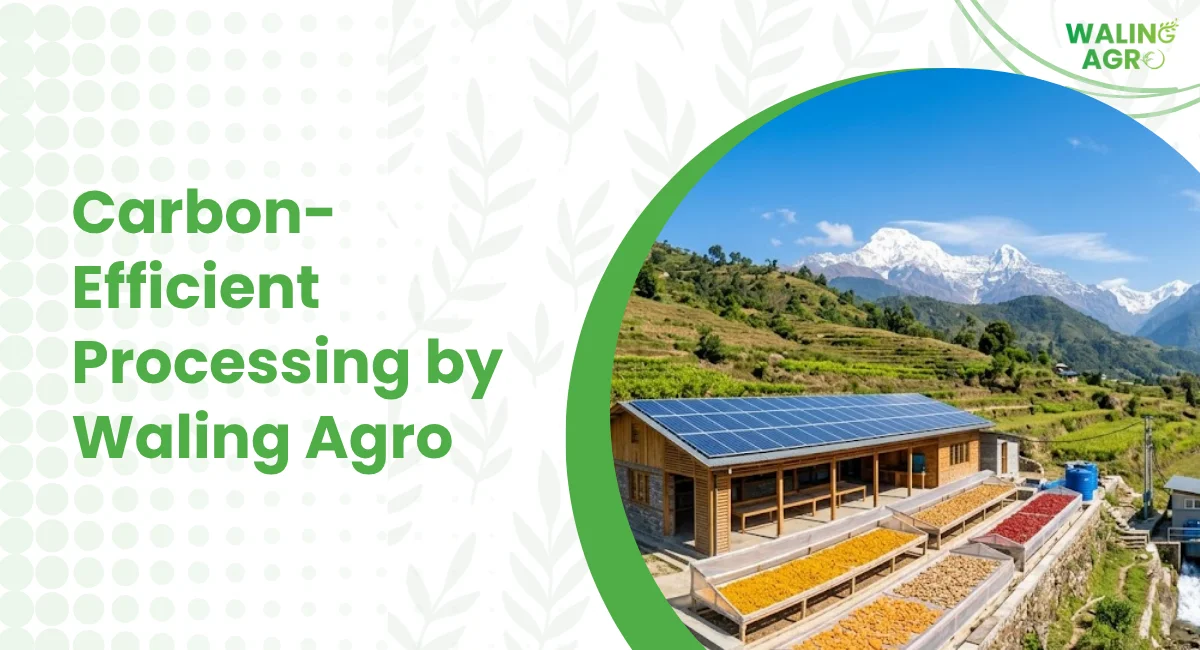
Carbon-Efficient Processing by Waling Agro

The global food system has a carbon problem. According to the United Nations Food and Agriculture Organization, global food system emissions reached an estimated 18 billion tonnes of carbon dioxide, accounting for roughly 34% of all human-caused greenhouse gas emissions.
Within that staggering figure, the processing and supply chain stages are the fastest-growing contributors, with pre- and post-production emissions growing by 45% between 2000 and 2020 alone. For an agro-industry handling spices and preserves deep in the hills of Western Nepal, ignoring this reality is simply not an option.
At Waling Agro, we believe the responsibility to act falls on every producer, regardless of size. That is why we have built our entire processing chain around a single principle: use renewable energy at every stage, from the moment the raw harvest arrives at our facility to the moment the finished product leaves our gate.
Nepal’s Renewable Energy Advantage
Before explaining what we do, it is worth understanding the energy landscape that enables our approach. Nepal is extraordinarily well-positioned for a renewable-powered industry.
Use of Hydroelectricity
As of 2022, around 98.5% of Nepal’s installed electricity capacity comes from hydroelectric plants, reflecting the country’s remarkable progress in clean power development. This is the product of a landscape carved by some of the most powerful river systems on earth.
Nepal’s total hydroelectric potential is approximately 83,000 megawatts, of which an estimated 45,000 MW are considered economically and technically viable. To put that in perspective, the country is currently utilizing only a small fraction of what is available.
Between 2018 and 2022 alone, Nepal doubled its installed electricity capacity from 1,069 MW to 2,100 MW. And as of early 2025, Nepal’s total installed electricity capacity stands at 3,421 MW, with 3,255 MW, over 95%, coming from hydropower alone.
Solar Power
Alongside its extraordinary water resources, Nepal is equally blessed with sunshine. The average global solar radiation in Nepal varies from 3.6 to 6.2 kWh/m² per day, and the sun shines for approximately 300 days per year.
This totals to nearly 2,100 sunshine hours annually, with an average of 6.8 hours of bright sunshine each day and an average insolation intensity of 4.7 kWh/m²/day. For a facility that processes high-value agricultural produce like ginger, turmeric, black cardamom, and Lapsi, these two natural resources, water and sunlight, represent an immense, freely available energy infrastructure.
Stage One: Hydropower-Driven Processing Machinery
Every piece of machinery inside our processing facility, from cleaning and sorting lines to grinding, blending, and packaging equipment, runs exclusively on Nepal’s national grid electricity. Because almost all of Nepal’s electricity comes from hydropower, choosing grid electricity in our context is functionally equivalent to choosing a zero-direct-emission energy source.
There are no diesel generators, no LPG burners, and no coal-fired heat powering our production line. This matters enormously when you understand the scale of the problem in conventional food processing.
The shift toward sustainable energy in food production is a critical step in addressing global climate challenges. Here is a breakdown of the key points from your content:
- Significant Energy Footprint: The food industry is responsible for roughly 30% of the world’s total energy consumption.
- Emission Contributions: Food processing activities alone account for nearly 26% of global greenhouse gas emissions.
- Fossil Fuel Reliance: A major portion of this environmental burden stems from fossil-fuel-powered processing machinery.
- The Hydropower Solution: By transitioning to hydropower electricity from the very first stage of the production line, machinery-related emissions can be entirely eliminated.
Stage Two: Solar and Sun Drying
Drying is one of the most energy-intensive steps in processing spices, herbs, and agricultural produce. Across the conventional industry globally, this single operation carries a disproportionately heavy carbon cost.
For products like our Akabare chilies, Lapsi (hog plum), Timur (Nepali Szechuan pepper), ginger, and turmeric, drying is essential for quality preservation and extending shelf life. Our answer to the fossil-fuel drying problem is to harness the most abundant resource Western Nepal has to offer: the sun itself.
For premium products like our garlic and moringa range, where precise moisture levels are critical to final quality, this hybrid solar-electric system gives us both the environmental credentials and the product consistency our buyers expect.
Drying is a critical, non-optional requirement for preserving the quality and shelf life of agricultural produce like Akabare chilies, Lapsi (hog plum), Timur, ginger, and turmeric. However, in the conventional food industry, this single operation carries a disproportionately heavy environmental price tag.
Harnessing the Power of the Sun
Our solution leverages the most abundant resource in Western Nepal: The Sun. With nearly 300 sunny days per year, we utilize direct sun drying and solar-assisted drying as our primary methods.
Efficiency and Emission Reductions
- Renewable Energy: By using freely available solar energy, we bypass the need for traditional energy sources.
- Sustainability Gains: Research confirms that solar drying systems achieve nearly 56% energy savings and an equivalent reduction in CO₂ emissions compared to traditional hot-air dryers.
- Total Elimination: Advanced solar-photovoltaic-assisted hybrid systems can reach a 100% reduction in traditional energy consumption and CO₂ emissions.
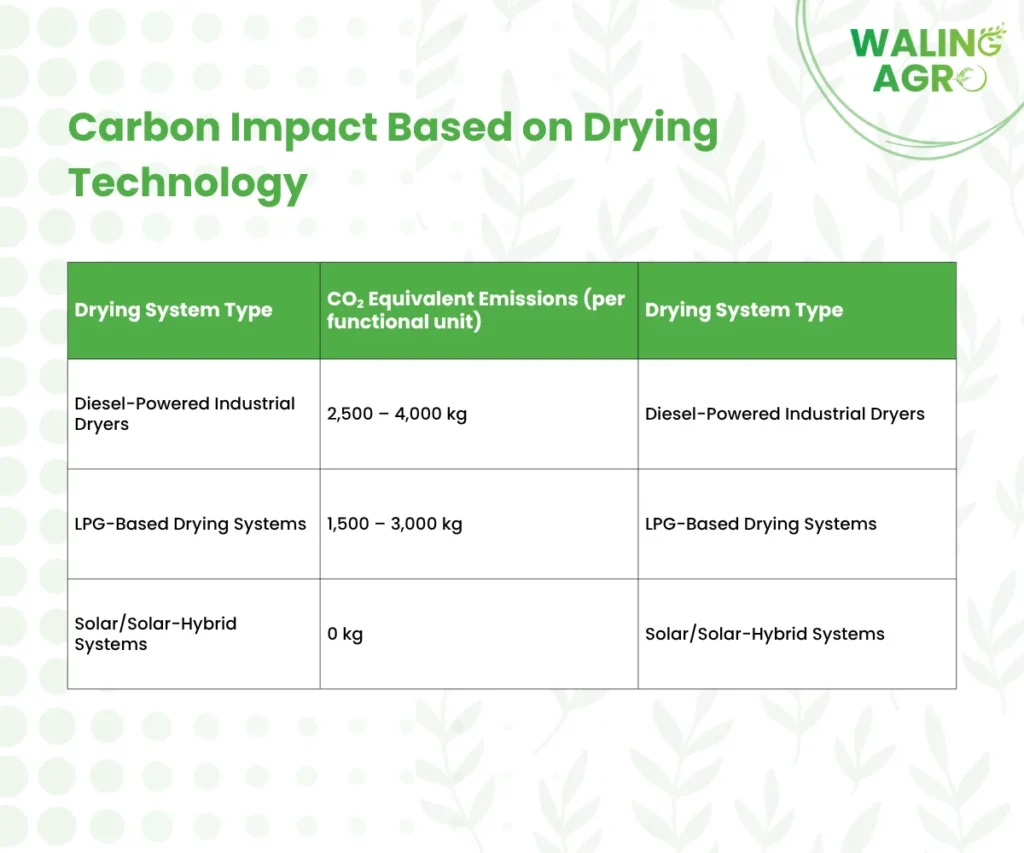
Comparative Carbon Impact
The contrast between solar-based drying and fossil-fuel-powered alternatives is significant:
Why This Matters for Every Product We Make
The spices and foods we process at Waling Agro are premium, naturally cultivated products sourced directly from smallholder farmers in the mid-hills of Western Nepal. These farmers have an inherently low-carbon agricultural footprint. They farm without heavy machinery and without synthetic chemical inputs at industrial scale.
It would be a direct contradiction to take those clean, authentic products and then subject them to carbon-intensive industrial processing. Our renewable energy processing chain is designed to honour the integrity of what our farmers grow.
The evidence also clearly shows that processing itself is a meaningful tool for reducing overall food system emissions: durable processing and refrigeration can help prevent food waste. By processing and preserving products like dried ginger, turmeric powder, and Lapsi using renewable energy, we are simultaneously extending shelf life, preventing waste, and doing so without adding to the planet’s carbon burden.
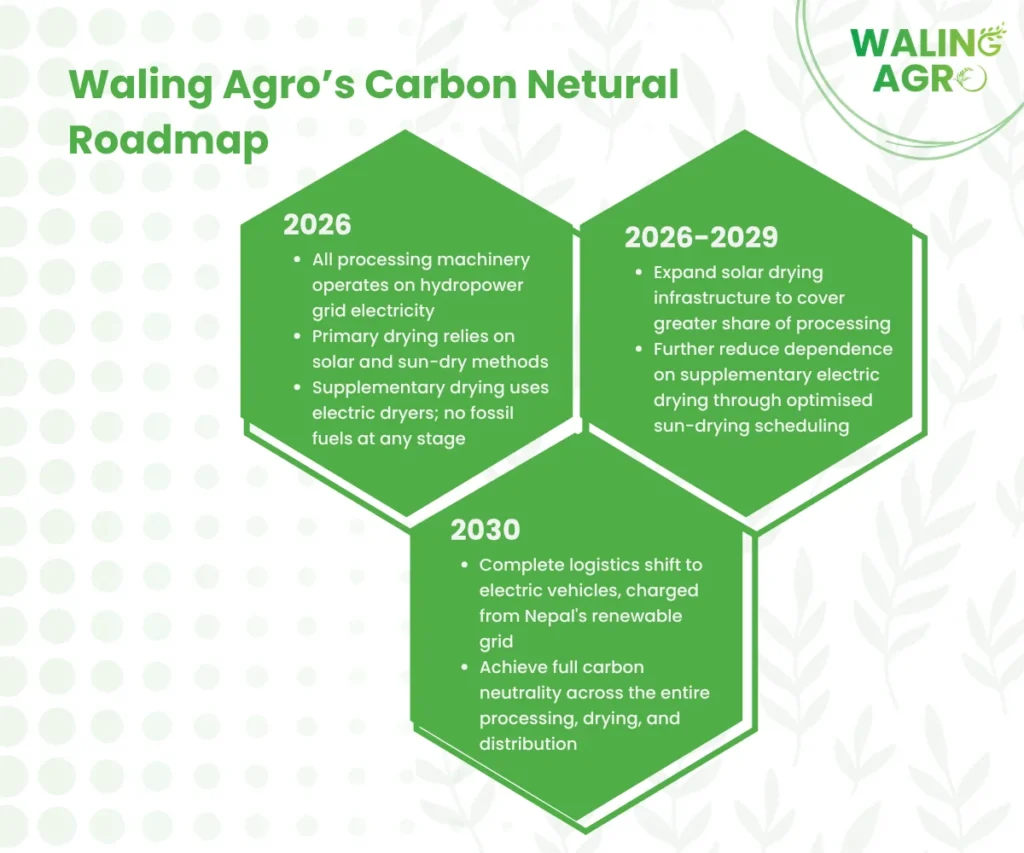
Our Carbon-Neutral Roadmap to 2030
Our commitment to carbon-efficient processing is not static. We have a clear, staged pathway to full carbon neutrality:
Conclusion
The global food industry’s carbon footprint is enormous, but it is not inevitable. At Waling Agro, we have demonstrated that a small agro-industry operating in the heart of the Himalayas can build a processing chain that is commercially viable, quality-driven, and genuinely aligned with the planet’s climate future.
When you partner with or purchase from Waling Agro, you choose authentic Nepali spices and foods. You are choosing a supply chain that is actively working to leave the world a little cleaner, one solar-dried batch of ginger at a time.