What is Curcumin and Why Does it Matter in Turmeric?

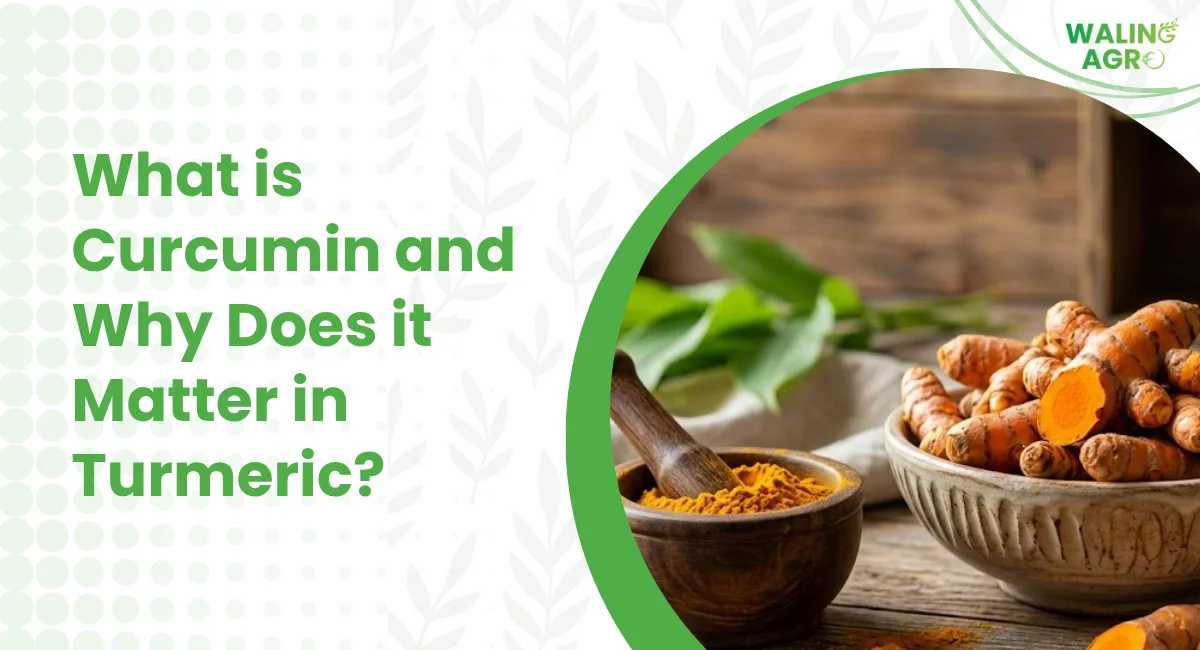
Turmeric is one of the most studied spices on earth. It has been used in Ayurvedic medicine for more than 4,000 years, and in recent years it has become one of the fastest-growing ingredients in the global food and supplement industry. The global turmeric market was valued at USD 5.86 billion in 2024 and is projected to reach USD 10.32 billion by 2033. Curcumin, the bioactive compound inside every turmeric rhizome, is driving that growth.
But here is the question most buyers never ask: not all turmeric contains the same amount of curcumin. The percentage varies by variety, altitude, soil, and processing method. A turmeric that looks identical to another on the shelf may deliver a fraction of the active compound.
At Waling Agro, we source and process turmeric from the mid-hills of Western Nepal, a region with documented naturally high curcumin content. This article breaks down what curcumin is, what science says about its benefits, why curcumin percentage is the single most important quality indicator, and why where your turmeric is grown matters more than the label.
What is Curcumin?
Curcumin is a naturally occurring polyphenolic compound found in the rhizome of Curcuma longa — the turmeric plant. It belongs to a family of compounds called curcuminoids, which give turmeric its vivid yellow-orange colour and most of its biological activity.
| Curcuminoid | Share of Total | Primary Role |
| Curcumin | ~77% | Main anti-inflammatory + antioxidant agent |
| Demethoxycurcumin | ~17% | Antioxidant support |
| Bisdemethoxycurcumin | ~6% | Anti-inflammatory support |
Harvard Medical School describes curcumin as the biologically active compound in turmeric, stating that turmeric’s potential health benefits are primarily due to curcumin. Every meaningful health claim associated with turmeric traces back to curcumin.
The Science Behind Curcumin’s Health Benefits
Six health areas stand out with the strongest clinical evidence:
| Area | Key Finding | Source |
| Anti-inflammatory | Interrupts key inflammatory signalling pathways at the molecular level | Frontiers in Pharmacology (2025) |
| Antioxidant | Neutralises free radicals and stimulates the body’s own antioxidant enzyme systems | 7,000+ peer-reviewed studies PubMed |
| Joint Health | Recommended by the Arthritis Foundation for osteoarthritis and rheumatoid arthritis symptom management | Harvard Medical School |
| Blood Pressure | Significant beneficial effect on regulating both systolic and diastolic BP vs. placebo in adults | Frontiers in Pharmacology 2025 |
| Liver & Metabolism | Attenuated liver steatosis in obese Type 2 diabetes patients via antioxidant and anti-inflammatory pathways | PubMed |
| Cancer Research | Anti-proliferative activity and induction of apoptosis. Phase III/IV trials underway for arthritis and oral diseases | Frontiers in Pharmacology 2025 |
Why Curcumin Percentage is the Most Important Quality Marker
Walk into any supermarket and you will find shelves lined with turmeric products, most labelled simply as “turmeric powder” with no curcumin percentage stated. Turmeric spice typically contains between 2% to 9% curcumin, while pharmaceutical-grade supplements can concentrate this to 95%. For culinary use, the raw percentage of your powder determines your daily intake.
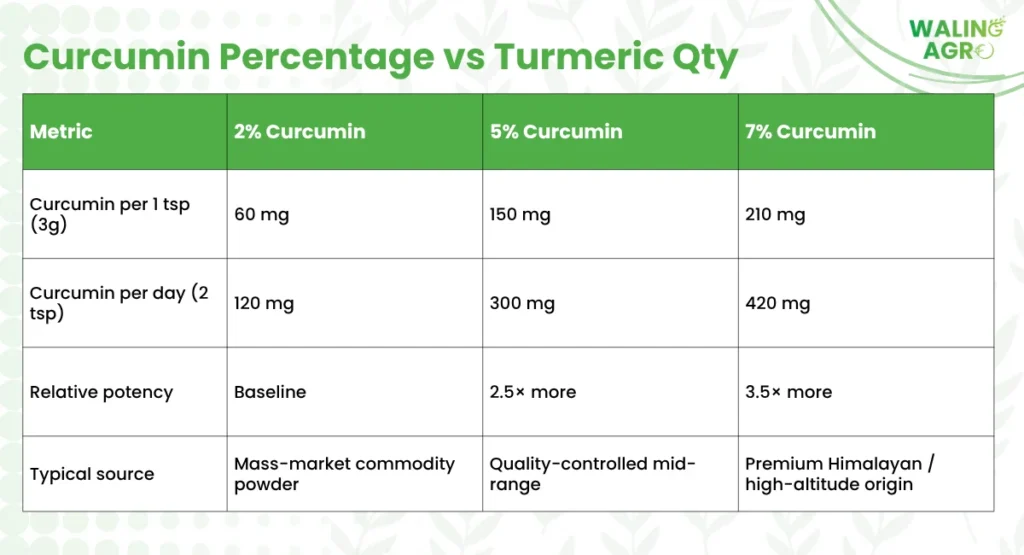
The same daily ritual, with the same spoon, produces radically different outcomes depending on the quality of the turmeric you are using. Research on turmeric production in Surkhet district, Western Nepal found a curcumin content of 4.89% in turmeric produced under traditional cultivation practices.
Why Nepali Turmeric Has Naturally Higher Curcumin
Turmeric grown in the fertile foothills of the Himalayas boasts an intense aroma, earthy flavour, and higher curcumin content compared to conventionally grown alternatives. This is the result of measurable environmental and agricultural factors.
| Growing Factor | How It Affects Curcumin | Nepal Advantage |
| Altitude | Significant day-night temperature variation at 600–1,600 m elevation stimulates secondary metabolite (curcuminoid) synthesis as a plant stress response | Mid-hills grow between 600–1,600 masl |
| Soil richness | Forest-edge terrace soils built over centuries of organic farming accumulate rich organic matter, producing denser secondary compounds in rhizomes | No synthetic fertiliser in traditional plots |
| Climate | Warm growing season + cool nights = optimal curcuminoid biosynthesis. Studies confirm curcuminoid content is related to geographical location and temperature | Himalayan foothills provide this natural variation |
| Cultivation method | Nepal turmeric is of high quality compared to other producing countries and has high export potential in value-added international markets | Smallholder farmers use inter-cropping and compost, not chemicals |
How Waling Agro Protects Curcumin Through Processing
Growing high-curcumin turmeric is only half the story. Curcumin is sensitive to heat, light, and moisture, and poor post-harvest handling can destroy a significant portion of the active compound before a product reaches the buyer. Every stage of our processing is designed to preserve, what the rhizome naturally contains.
1. Washing & Sorting
We clean rhizomes immediately after harvest. This prevents microbial growth on the surface, which can penetrate the flesh and degrade the curcuminoids.
2. Solar & Controlled Drying
We use primary solar drying, taking advantage of Nepal’s 300+ sunny days per year. Curcumin degrades above certain temperatures; solar drying preserves curcumin content far better than high-heat industrial tunnel drying. See our carbon-efficient processing approach for full detail.
3. No Adulteration
Waling Agro guarantees a 100% pure product. We never use synthetic colorants, which are sometimes added to commercial turmeric to mimic the deep orange hue of high-curcumin rhizomes.
4. Whole Rhizome Grinding
We only mill whole, dried rhizomes. We strictly avoid the common practice of blending in stem or leaf fiber, ensuring that every gram of powder is derived from the potent root itself.
5. Light-Protected Packaging
Curcumin is light-sensitive and degrades when exposed to UV rays. Our specialized packaging blocks light and seals out humidity, ensuring the turmeric stays as potent on your shelf as it was on the day it was milled.
How to Choose Turmeric the Right Way
Given how much curcumin content varies, here is a practical guide to choosing turmeric that actually delivers on its health promise:
| What to Check | What to Look For |
| Origin | Turmeric from verifiable, specific growing regions — particularly the mid-hills of Nepal and traditionally high-quality areas of India — consistently outperforms anonymous commodity powder. Ask where it was grown. |
| Processing transparency | Legitimate premium producers can tell you how rhizomes were dried, how the powder was milled, and what quality controls were applied. If a supplier cannot provide this information, that is itself an answer. |
| Signs of adulteration | Pure high-curcumin turmeric has a deep, resinous colour, a distinctive earthy and slightly peppery aroma, and a light astringency on the palate. Uniformly bright yellow powder with little aroma is frequently adulterated with starch, chalk, or synthetic colorants. |
| Combination method | Always pair turmeric with black pepper and a fat source. The 2,000% bioavailability increase from piperine applies to food-source turmeric just as it does to supplements. Without it, even the best high-curcumin turmeric will be poorly absorbed. |
| Whole vs. isolated | Whole-rhizome turmeric powder preserves the complete nutritional matrix — curcumin, essential oils, minerals, and fibre — in a way that isolated curcumin supplements do not. For daily culinary use, whole-food turmeric is the superior choice. |
Conclusion: The Gold Standard Starts at the Root
Curcumin is the reason turmeric is a superfood. It is the compound behind thousands of research papers, the mechanism of action behind every anti-inflammatory and antioxidant benefit the spice is known for, and the primary quality differentiator between a premium turmeric and a commodity one.
The curcumin content in your turmeric is determined long before it reaches the shelf, it is determined in the soil where the rhizome was grown, the altitude at which it developed, the farming practices that nurtured it, and the care taken in drying and milling. Nepal’s mid-hills offer an exceptional combination of every one of these factors.
Explore our full range of spices and naturally processed foods from Western Nepal, including ginger, black cardamom, Timur, and moringa, or contact us directly to discuss sourcing and wholesale enquiries.